


















![How to Build an Enterprise Context Layer for AI [2026 Guide]](https://website-assets.atlan.com/img/blog/enterprise-context-layer-what-is-og.png)
How To
How to Build an Enterprise Context Layer for AI [2026 Guide]
Build an enterprise context layer for AI in 4-8 weeks. Five steps: Enterprise Data Graph, Context Agents, Context Engineering Studio, and Context Lakehouse.
June 11, 2026
Connect all your business systems and pull context across your data estate into one living graph.


Give humans the context they need to understand your business.
 Slack
Slack Teams
Teams Claude
 ChatGPT
AI teammates that document tacit knowledge and make your data AI-ready.

Bootstrap, test, and ship the business understanding every AI needs.
 Cortex
 GenieClaude
 Codex
Codex
The world's first context store engineered natively for AI.
Finance
Technology
Manufacturing
Media
Healthcare
Retail
We're writing down everything we learn. 1344+ articles, how-to guides, and resources on data governance, context engineering, enterprise AI and more
Use the search or filters below to find what you need.
Looking for downloadable guides, blueprints, or courses?Visit Atlan's Resource Center →
Build an enterprise context layer for AI in 4-8 weeks. Five steps: Enterprise Data Graph, Context Agents, Context Engineering Studio, and Context Lakehouse.
June 11, 2026
Compare the best data lineage tools for your data and AI stack, with key capabilities and commercial versus open-source options.
June 10, 2026
88% of AI agent projects fail to reach production. Learn 13 named anti-patterns across architectural, execution, and data-layer tiers — and how to fix them.
June 10, 2026
Activate your data catalog as an AI agent memory layer via MCP. Six metadata types, three integration paths, and proven accuracy benchmarks are included.
June 10, 2026
Test context quality for AI agents using golden datasets, A/B testing, freshness checks, and production trace reviews to ensure accurate grounding.
June 10, 2026
Learn what a context repository is, what it contains, how it improves agent context, and why versioned, governed context matters for enterprise AI.
June 10, 2026
AI agents cold-start when context is missing. Learn the two forms of the problem — session and organizational — and how enterprise memory layers address both.
June 10, 2026
Context drift causes AI agents to reason over stale definitions with no error signal. Learn the three root patterns and how Atlan's context lineage detects drift before it reaches production.
June 10, 2026
Context drift detection finds when metadata feeding AI agents has gone stale, before models fail. Learn 3-layer taxonomy & how active metadata catches it.
June 10, 2026
A practical architecture guide for shared context repositories, MCP, A2A, memory, governance, and decision traces in multi-agent AI systems.
June 10, 2026
Learn how to upgrade RAG agents with governed context, graph lookup, compression, testing, and MCP-style delivery for enterprise AI systems.
June 10, 2026
Context graphs link data assets dynamically. Ontologies define the vocabulary that makes them interpretable. Learn how Atlan's Context Layer connects to 75+ data systems and exposes a live, queryable context graph , covering asset definitions, lineage paths, and access policies , that AI agents traverse at inference time via a native MCP server, delivering the operational context an ontology alone cannot provide.
June 10, 2026
Context infrastructure for AI agents spans protocol, delivery, and governed data substrate layers, determining what agents know, trust, and act on.
June 10, 2026
A context layer for AI agents gives every agent governed business meaning, identity, and lineage. See how it works and what it replaces in your stack.
June 10, 2026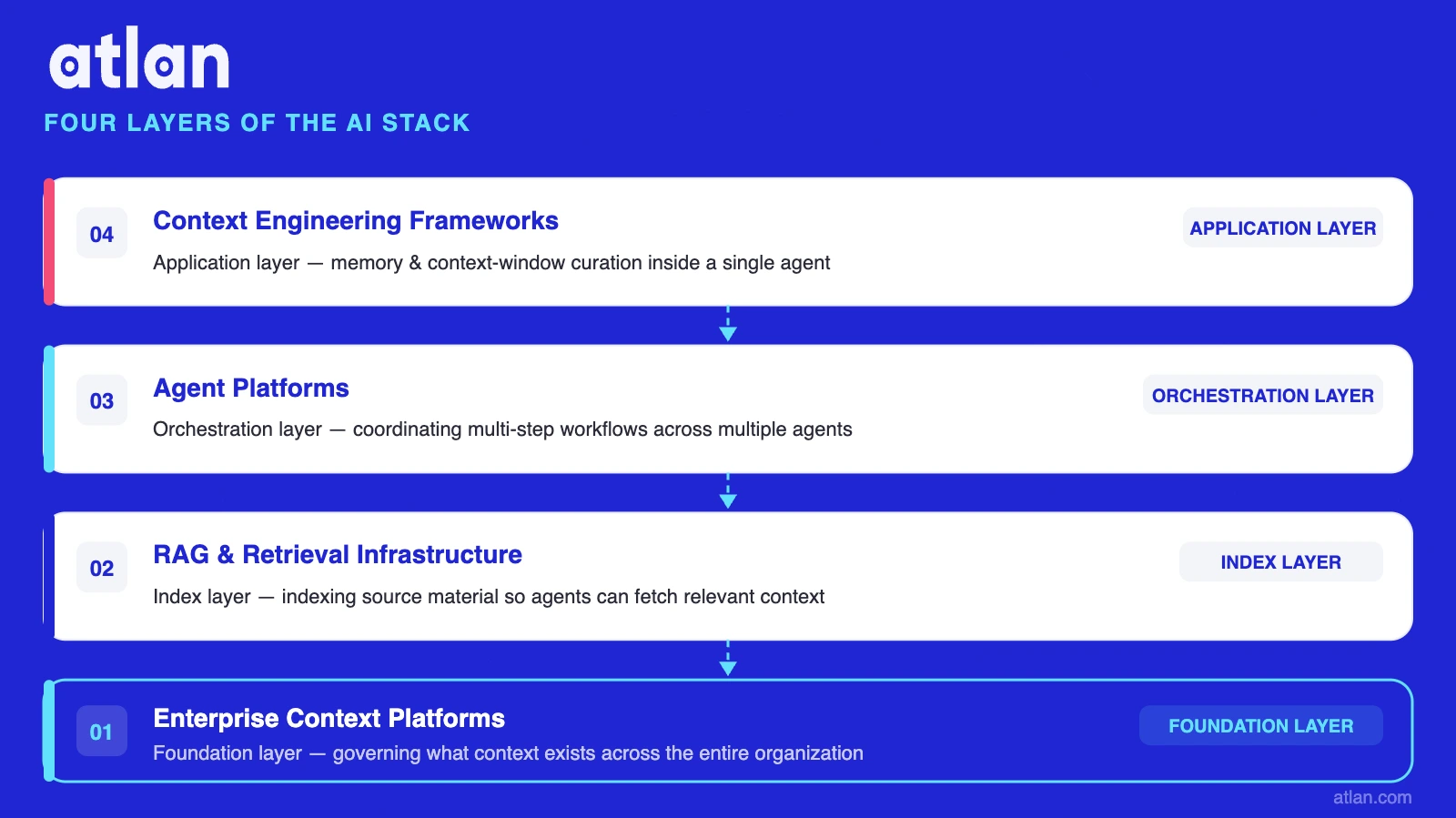
Context management software splits into four categories: frameworks, RAG, agent platforms, and enterprise context. Here's which one your AI agents need.
June 10, 2026
Contextual intelligence in AI depends on governed data, not just better models. Learn how RAG accuracy, source quality, and data governance determine AI outcomes.
June 10, 2026
Compare in-context and external memory for AI agents — covering token costs, retrieval latency, accuracy, and when each architecture fits your use case.
June 10, 2026
Learn why LLMs favor the start and end of a context window, how that breaks RAG and agents, and how governed context delivery improves accuracy.
June 10, 2026
Poor data quality degrades LLM outputs. Learn the key standards, evaluation methods, and tools for building and maintaining accurate LLM knowledge bases at scale.
June 10, 2026
Learn how to score and manage knowledge base freshness in RAG systems. Covers embedding lag, stale retrieval rate, coverage drift, and active metadata solutions.
June 10, 2026
Understand what causes LLM knowledge base staleness, how to score content freshness, and automated strategies to keep your knowledge base accurate and current.
June 10, 2026
Learn the main types of AI agent memory — episodic, semantic, and procedural — and how each type shapes agent behavior, accuracy, and long-term reliability.
June 10, 2026
Learn how decision traces create compounding value for AI agents by capturing organizational reasoning, building institutional memory, and enabling autonomous decision-making at scale.
June 10, 2026
The context layer is owned by the data platform team in centralized orgs or domain teams in federated architectures. Learn how to choose the right model.
June 10, 2026